
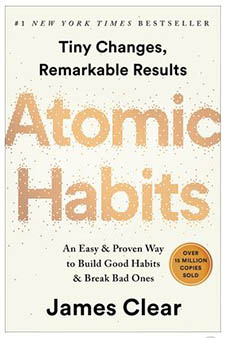
For as much as I favor fiction in my reading stack — and I do — I also like the occasional nonfiction read. It just so happened I came across a book club at work, and James Clear’s 2018 bestseller, “Atomic Habits,” is its next read. I’ve always been a little curious about it, so this was the perfect reason to throw it in my cart at Target.
Let’s dispense with the thumbs up or down first …. should you read this, if you haven’t already? It depends. If you are woefully or even just mildly off-track in your life, looking for some guidance, and need that advice delivered in clear, manageable chunks, you could find this book useful. Nothing Clear says when it comes to forming better habits for a better life does not make sense. His four laws to establishing good habits are nothing if not common sense: Make It Obvious, Make It Attractive, Make It Easy and Make It Satisfying.
And as someone that is really in her element when things are in order, I can relate. For example, I find cleaning, or just being in a clean environment, soothing. Delightful. Dare I say, luxurious. This is not to say my environment is always clean and orderly. My desk right now is covered in pens and paper and I really need to declutter. I’m just saying I am at my happiest when things are in their place. Ask my kids how I feel about their coats being on the back of a chair instead of hanging from a coathook.
I also live or die by the concept of habit stacking, which Clear discusses. My morning, for example, is a mountain of habits which I use to navigate my way into my daily work routine, starting with getting up at 5 a.m. and walking my dog five miles. Then it’s home, and if it’s Monday or Thursday I am changing the cat box. Friday? It’s sheets into the washing machine. Then it’s shower, coffee, yogurt and blueberries. Then it’s Wordle. I find the repetition wildly comforting.
Habits are amazing.
Clear also reminded me that perspective can play a big role in how we tackle self-improvement projects, work-related challenges and family initiatives. There’s good stuff in these pages.
All this said, I think the biggest challenge for me in reading books like this and others — think Grant, Gladwell, etc. — is that so often, the authors are coming from a place of privilege. I’m not holding this against them. Their upbringing is their upbringing. And it’s also possible any personal growth or “think different” author, *most* of the time, may argue they did experience adversity. I’m sure they did. But you can experience tragedy, injury, misfortune and so on and still come from a place of privilege. Which can make it difficult for advice to always resonate the way it’s intended.
There were more instances of that for me with this book than others. For example, Clear talks about a part of breaking a bad habit, in some cases, being as simple as changing your environmental triggers — something not everyone has the financial means to do. In another section on establishing anticipatory actions that can be transferred to another situation, his example was something to the effect of, “Feeling sad about life? Take three breaths and smile.” Now c’mon, James. I get that his commentary there is to be taken in context when, let’s say, the reader is coping with clinical depression. But the way it’s stated feels awfully cavalier. Many of his suggestions and examples are something you can see a 35-year-old man with an office job doing, not a 23-year-old single mom. If you can dig through the examples and apply your own context, his advice can make sense. You just have to work a little harder at it.
If nothing, I appreciate the habit validation. And the reminder that there are a lot of things I don’t *have* to do, but I *get* to do. That was worth the price of admission for this read.
 LitzyDitz
One thought