
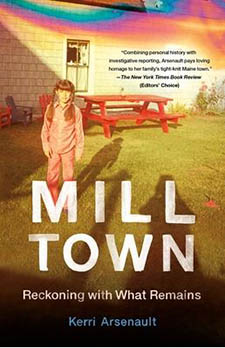
Any number of headlines for this review popped into my head as I sat down to write … “Smoke ‘Em While You Got ‘Em” … “It’s Really Not Up To You” … “Stop with the Organic, I Don’t Think it Matters Anymore” …
“Mill Town” is not an especially joyful read.
Rather, Kerri Arsenault’s memoir about the small blue-collar town in Maine in which she grew up is engaging. It’s insightful. It’ll stop and make you think about your own roots, and the meaning in their marrow.
I’ve had Mill Town on my TBR list for quite some time since I noticed it on a friend’s Insta feed a while back. Ms. Arsenault’s hometown, Mexico, Maine, owes its initial existence to a paper mill that was built way way back in the day by a man with designs on creating a strong community with a better standard of living than the traditional mill town. Nicer homes, better amenities, all nestled up against the Androscoggin River.
Having married into a family that also had its livelihood attached to a paper mill — this one in Muskegon, Michigan — I was intrigued by the premise that the author set out to prove or disqualify: that the cancer that took her father, along with many other townsfolk, had something to do with the toxins spewed into the air and released into the water and buried in the ground by mill operators. My father-in-law lost his life to cancer before my husband and I even walked down the aisle, gone only a couple of years after turning 50.
Mill Town is not a thriller with a suspenseful ending — there is no conclusive resolution to the question, “Was it the mill that did it?” Instead, it’s a sociological deep dive into the meaning of community, particularly in areas like Mexico, Maine (or for that matter, Muskegon, Michigan) where the history of the land starts long before the first factory was built.
Mexico was built on the Acadian culture — migrants from Canada with a strong-as-bedrock work ethic and common sense approach to life. You don’t grow up in the cold, snowy denizens of the North without a little bit of fatalist in you.
As Arsenault gets down to business about the goings on at the mill, she spends much of that time talking with longtime residents — people from her past that know her as “Maddy’s daughter” — and gaining a much deeper understanding of why people stay in a place that has become economically inhospitable.
Is it easier to stay? Does the comfort of what you know outweigh the possible benefits of what’s beyond the four corners of your downtown? The author does an exquisite job of portrait painting here, in that readers aren’t allowed room to pity or judge the decisions of those that stayed in their hometowns. The pride is palpable. The reasons are valid.
If anything, readers are gently ushered toward a quiet outrage at the powers that be — whether that’s local government acting in disregard for long term health consequences or corporations taking small towns down for a quick buck. It’s both frustrating to read and fascinating to be reminded of all the roadblocks thrown up in the way of anyone just trying to bust out or get ahead.
Admittedly, Mill Town was a bit of a niche read for me but the story resonates with anyone that has family and/or a town they left behind after they finished high school. It’s a book that’ll make you think about your origins and what made you, you. Take the time.
 LitzyDitz
One thought