
When I was in high school, I crushed on Mark Harmon. Such. A. Hottie. I loved him in “St. Elsewhere.” Then he went and gave me the ick by starring in “The Deliberate Stranger,” which chronicled Ted Bundy’s serial killing spree. How could someone that seemed so charming and gorgeous be such a bad guy? OK, he redeemed himself with his stint as a Secret Service agent on “The West Wing.” But TDS to this day is one of the saddest/cringiest things I’ve ever watched.
(Pausing early in this post for a shout out to Gen Xers that had to endure some really terrifying miniseries television experiences, such as the aforementioned “Stranger” alongside “The Day After.” If you ever wonder why we are pretty unflappable as a generation, you can thank the minimal TV options and network execs’ obsession with anything that would make you want to lock your doors and never leave your house. You know, like serial killers masquerading as charming single men just looking for a lift.)
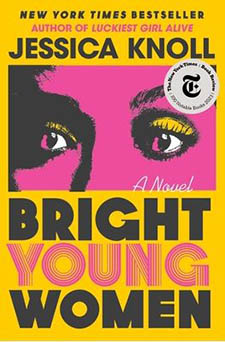
Author Jessica Knoll revisits the Bundy experience with “Bright Young Women,” a fictional look at a series of murders on the campus of and in the town home to Florida State University in the early 1970s. For anyone with a basic knowledge of Ted Bundy, the similarities become apparent pretty quickly. That said, those shared details don’t detract from the story Knoll weaves as it centers around a trio of women — Pamela, the story’s primary narrator; Ruth, a young woman coming to terms with her family dysfunction alongside her personal sexuality; and Tina, a young widow determined to avenge the death of her soulmate.
Told over the span of about 45 years or so, Knoll bounces back and forth between the times of the murders in the late 70s and present day-ish. Justice does not wear a watch. In the story’s opening, we meet Pamela, the president of her sorority and the one to come upon “the defendant”‘s carnage one early winter morning. As she starts to navigate multiple challenges — grieving the death of her best friend, keeping the sorority together, coming to terms with her true feelings about her boyfriend, and trying to help the authorities catch the killer, she meets Tina — a woman that is, in a lot of ways, her mirror image a few years ahead of her.
Tina, too, has a complicated past and an eccentric present — so much so that she isn’t trusted by many. But Pamela is, to the author’s point, a bright young woman, and she can see through bullshit. To her, Tina isn’t slinging any. She’s just another woman also trying to catch a killer. Ruth’s killer.
Ruth is the victim that brings the story to life and offers a human perspective so that readers can also come to wish all the bad things on the defendant. What’s worse is that the defendant isn’t the only person to try and take her life. Turns out it’s possible to kill a soul with just a few words.
I’ve read at least two other Jessica Knoll books, and while I am not hugely into thrillers (ha — says the girl that reads all things Stephen King), I think she does a splendid job at capturing attention, creating realistic characters, keeping the momentum moving forward and keeping the story fairly tight. Like anything these days, it took me way longer to read it than it should have — if you have an open weekend, my guess is you could get in and out in a couple of days.
Great for a summer beach weekend or for just hanging out on a porch. Just say no, though, when some guy wearing a sling asks for help putting something in his car. You’ve been warned,
 LitzyDitz
One thought