
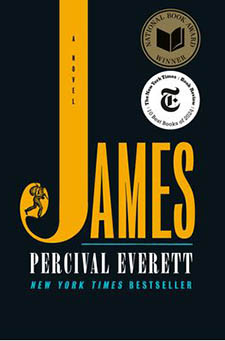
I should not have sat on this one.
Percival Everett’s “James” was one of the “It” books last year — so much so that I got a little contrarian about it, dug my heels in a bit, and even talked myself into a convoluted justification for not reading it. It felt like homework, I said, based on my elementary understanding of its premise — that it was a retelling of Huckleberry Finn from Jim the runaway slave’s perspective.
And I was not really a huge fan of Mark Twain when it came to required reading in middle school. By that point, I was nose deep into V.C. Andrews and Stephen King.
So was I really going to enjoy “James?”
Um, YES. Yes I did.
Everett’s use of language as a central theme is not new to me — while “Erasure” is still on my TBR list, I did see “American Fiction.” And like that screenplay, the main character’s (in this case, James) understanding of language and its ability to define you is a key plot point throughout the novel.
James, after all, is perfectly capable of punching above his perceived weight when it comes to spoken English, and so can all of his friends and family. James, in fact, goes so far as to have to teach a “slave” vernacular to his daughter and other slaves’ children so that can stay below the radar and not attract unwelcome attention.
This charade continues to serve as a saving grace throughout James’ journey down the Mississippi with Huck and alongside other characters he meets along the way. Everett’s portrait of James is multi-faceted, nuanced and so human it’s impossible to not inhabit his feelings. He’s forced to make some version of Sophie’s choice several times throughout the story, and it’s because those inter-character relationships are so finely woven that we as readers can take on the agony James feels each time he’s confronted with a life-and-death-now-choose situation.
Having remembered precious little from Twain’s story of Huck, it’s impossible for me to pick up on all the connecting dots, which actually made the book even more enjoyable, I would guess. Everett takes great care with his use of both humor and pain to advance the narrative. To say this is a dark read is an understatement — there is a lot of awful — but it’s necessary and a massive reminder of what privilege looks like, even today.
“James” is beautifully written, a fast-paced read and well worth your time if you haven’t read it yet. It deserves all the flowers it received and serves as a reminder to me to get “Erasure” back on top of my TBR list.
Need more great recommendations? My blog has a bunch.


2 thoughts