
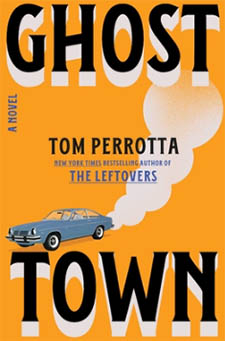
At the risk of this becoming more of a personal blog post than a book review, I gotta say, “Ghost Town” hit home.
I’ve always loved Tom Perrotta’s work and still think “The Leftovers” is one of the best books of this century. So I was thrilled to pick up his latest this summer to add to my TBR pile. I didn’t intentionally save this for an October read, though it in some respects fits the season.
I expected “Ghost Town” to be good. Perrotta’s work is always good. What I didn’t anticipate was how on the nose the narrative felt to a period of time in my childhood.
Our protagonist, a moderately successful author Jay Perry, tells the story of his younger self, Jimmy Perrini, the summer between 8th and 9th grade in early ’70s Creamwood, New Jersey. (A side note here for all my Gen X brothers and sisters who can’t pay attention to anything longer than 5 minutes — Perrotta has you covered.) In a series of short-to-really-short chapters, Jimmy breaks down the time immediately leading up to and after his mother’s death from cancer.
And this is where his story becomes so personal to anyone who lost a parent at a young age. For me, that was my father, as I was heading into 6th grade. And even though Jimmy’s mother had been ill, for Jimmy the loss felt sudden — he was scooted out of the house to go help his Little League team win the championship only to be picked up mid-inning by a relative because she has passed.
My experience was similar — a sudden death was I was away from the house. Babysitting. The couple comes home early, I am dropped off at a neighbor’s and the next time I see my mother, I am being told he died.
So I get Jimmy. I do.
I was struck by a line describing how everyone was acting about a third of the way in — “What was strange was how natural it had had felt while it was happening, as if everybody was just doing the best they could under some pretty miserable circumstances.” Yessssssss. It made me think back to those days and months after my father died, the same magical thinking taking place that Jimmy was experiencing. Maybe he really isn’t dead. Maybe I can talk to him through a Ouija board.
And the mutual disassociation that took place, however well-intended his father meant to be. His dad was a separate person grieving a separate relationship. His sister was old enough to see a light at the end of tunnel and an escape to a new life. Jimmy was adrift, and found solace in people that really didn’t have anythng to do with his age or station in life. A priest. A burnout. An older, misunderstood girl. His strange relatives living next door who were risking all sorts of chaos with a person of color living in a lily-white neighborhood in 1970.
All of this, so completely unrelated to the things he knew when his mother was alive. Reminders and feelings kept at bay by the awkward fascination of lifestyles he did not know or understand. The picture Perrotta paints is crazy realistic. It took me straight back to those feelings of just kind of sleepwalking through the days and nights, and exploring pathways I may not have, had my childhood not taken such a dramatic lurch. Those friends, at that time, I can now see as a salve on my heart when I didn’t even know what I needed and lacked the verbal or mental acuity to describe. Like Jimmy, I can look back at some with a sense of wonder in how we even connected at the time, but also appreciate those that have floated in, around and through my life so far.
If you love Tom Perrotta, you should definitely read “Ghost Town.” If you’ve never heard of Tom Perrotta, this is a great entry point into his catalogue. As mentioned above, it is super accessible with the pace of the narrative moving a a decent clip. And lots to break down if you are in need of a book club recommendation. This one is going to stick with me for a while. Thank you, Tom.

